Thinking about adding an ADU to your Garden Grove property? You are not alone. For many homeowners, an accessory dwelling unit can create more living flexibility, open the door to rental income, or make room for family without leaving the neighborhood you already love. The key is knowing what Garden Grove actually allows, what the process looks like, and where the numbers may or may not make sense. Let’s dive in.
Why ADUs Matter in Garden Grove
An ADU, or accessory dwelling unit, is a secondary housing unit on the same property as a primary home. According to the California Department of Housing and Community Development, ADUs are designed to be a lower-cost housing option that can support multigenerational living and create income potential through longer-term rentals. You can review the state’s current rules in the 2026 ADU Handbook.
For Garden Grove homeowners, that matters because the city’s current ADU ordinance is intended to align with state law. In practical terms, ADUs are treated as a permitted housing use, not a special exception that depends on a public hearing or discretionary approval. That makes Garden Grove a workable city for ADU projects when your lot and design meet the objective standards.
What You Can Usually Build
Garden Grove allows ADUs on single-family lots and also permits them on lots zoned for multifamily residential use. On a single-family property, you may generally build one ADU and/or one JADU, based on the city’s current Chapter 9.54 regulations.
A JADU, or junior accessory dwelling unit, is the smaller option. In Garden Grove, a JADU must be located within the walls of the main single-family home or an attached garage, cannot exceed 500 square feet, must include its own entrance and an efficiency kitchen, and requires owner occupancy in either the JADU or the main home.
For many homeowners, the real decision is not just whether an ADU is allowed. It is which ADU type fits your goals, your budget, and your site.
Detached ADUs
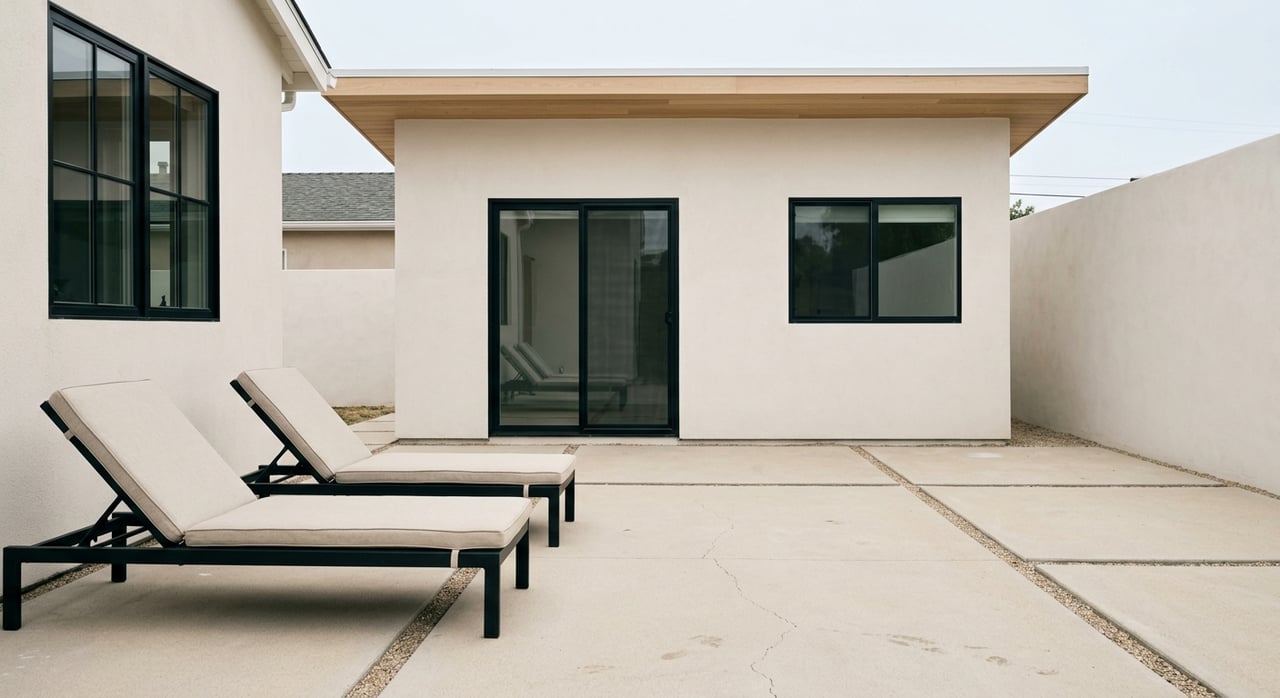
Detached ADUs usually offer the most privacy and flexibility. In Garden Grove, a detached studio or one-bedroom ADU can be up to 850 square feet, while a detached ADU with two or more bedrooms can be up to 1,200 square feet.
This option often works well if you want a separate living area in the backyard. It can also make sense if your long-term plan includes housing a relative or creating a stand-alone rental unit with independent access.
Attached ADUs
Attached ADUs are built as an addition to the primary house. Garden Grove allows attached ADUs up to 850 square feet or 50% of the primary dwelling’s floor area, whichever is less, with an 800-square-foot floor-area floor for smaller homes.
If you want to expand the existing structure rather than build a separate unit, this path may be worth a close look. Attached ADUs can sometimes make better use of a tighter lot while still adding real functionality.
Garage Conversions
Garage conversions are often the lowest-friction option. If you already have enclosed space that can be reused, a conversion may avoid some of the size, setback, and height issues that come with new construction.
Garden Grove’s code also says converted ADUs are not subject to the standard maximum size limits if the structure is reused without expansion. That can make a conversion especially appealing for homeowners who want to move faster or reduce construction complexity.
JADUs
JADUs are the most limited option, but they can be a smart fit for certain households. Because they stay within the existing home or attached garage, they may offer a simpler way to create housing space for family while keeping costs more contained.
JADUs also do not trigger extra parking requirements in Garden Grove. That can remove one common hurdle for homeowners with limited driveway or lot space.
Garden Grove Development Standards
Even though ADUs are broadly allowed, the details still matter. Garden Grove uses objective site standards, and your design needs to fit them.
For new attached and detached ADUs, the city generally requires four-foot side and rear setbacks. A detached ADU must also have six feet of separation from the primary home.
Height rules vary by project type. Most detached ADUs are capped at 16 feet, though Garden Grove allows up to 18 feet near transit or on certain multifamily sites. Attached ADUs may go up to 25 feet or two stories.
There is also a useful rule for homeowners working with existing structures. If your ADU is created by converting existing space without expansion, the project can often avoid the usual setback and height limits.
Parking and Utilities
Parking is still part of the picture for some Garden Grove ADUs, but it may be easier than you expect. The city generally requires one off-street parking space for a new attached or detached ADU, and that space may be located in a setback or arranged as tandem parking.
Just as important, Garden Grove cannot require replacement parking if you remove a garage, carport, covered structure, or uncovered space to build the ADU. The code also provides parking exemptions for ADUs near transit, converted ADUs, and certain other situations.
Utilities are often simpler than homeowners assume. Under Garden Grove’s rules, an ADU may share water, sewer, and other utility connections with the main home, while separate meters are optional if the utility provider allows them. JADUs must share utilities and cannot have separate meters.
How the Approval Process Works
One of the biggest advantages of California’s ADU laws is the review process. ADU permits must be handled ministerially, which means there is no discretionary review or public hearing.
According to the state ADU handbook and Garden Grove’s code, a complete application should be approved or denied within 60 days. The state also says an application becomes deemed complete if the city does not issue a written completeness determination within 15 business days.
That timeline can make ADUs feel more predictable than many homeowners expect. Predictable does not mean instant, but it does mean you are working within a clearer framework.
A local shortcut: ADU Go
Garden Grove offers a local resource that can help reduce front-end planning costs. Through the city’s ADU Go program, homeowners can choose from four free pre-approved plans ranging from a 447-square-foot studio to a 1,000-square-foot three-bedroom unit.
The city notes that these plans are code-compliant and pre-reviewed, which can help reduce pre-construction costs. There is also a 30-day review path for detached ADUs that use a city pre-approved plan.
That said, the pre-approved plans are not plug-and-play for every property. You still need site-specific items such as a site plan, structural plans, structural calculations, and Title 24 documentation. The city also notes that properties in Special Flood Hazard Area Flood Zone A cannot use the pre-approved plans, which is why the Planning Division should be one of your first stops.
How Long an ADU Project May Take
Permitting is only one phase of the full timeline. A regional planning guide from Santa Clara County estimates that the construction phase for an ADU typically takes 6 to 12 months, and many projects take 12 to 18 months from start to finish. You can view that benchmark on the ADU Santa Clara County build guide.
That is not a Garden Grove-specific rule, but it is a useful planning benchmark if you are comparing a garage conversion, attached addition, or detached backyard unit. It also helps set expectations for move-in timing.
Before occupancy, the ADU will need a certificate of occupancy, as noted in the state handbook. In other words, finishing construction and being legally ready to move in are not always the same date.
What an ADU May Cost
Cost is often the deciding factor, and the numbers can vary widely based on unit type, site conditions, and finish level. For local context, Garden Grove’s 2025 building permit valuation table lists garage conversion to habitable space, including ADU or JADU work, at $142 per square foot. You can see that benchmark in the city’s 2025 permit valuation table.
That figure should not be treated as a contractor quote. It is best used as a permit-valuation benchmark to help frame your budget discussions.
For a broader cost reference, a UC Berkeley survey found a statewide median ADU construction cost of $150,000, or about $250 per square foot. In Orange and San Diego Counties, the median was $130,000, or about $200 per square foot, while detached ADUs had a median cost of $180,000 and garage conversions had a median cost of about $90,000. Those figures come from the UC Berkeley ADU survey report.
Fees and possible savings
Under state law and Garden Grove’s code, ADUs under 750 square feet are exempt from local impact fees. Larger ADUs pay proportionate fees, and JADUs up to 500 square feet are also exempt from local impact fees.
That does not mean the project is fee-free. Garden Grove still separates planning, plan check, building permit, and utility connection charges from impact fees, so it is smart to budget for all of those categories.
Financing support
If you are exploring ways to manage upfront costs, the state points homeowners to several potential funding resources. The HCD ADU funding page notes that CalHFA’s ADU Grant Program can provide up to $40,000 to reimburse predevelopment costs, and it also highlights other options such as CalHome, Local Housing Trust Fund support, and some CDBG-related programs.
Availability and eligibility can change, so this is one area where timing matters. Still, it is worth checking before you assume all predevelopment costs must come out of pocket.
Rental Income Potential
For many Garden Grove homeowners, the financial case for an ADU depends on rental income. The city allows an ADU or JADU to be rented separately from the main home, but the rental term must be 30 days or longer. Short-term rentals under 30 days are prohibited.
That means the realistic income story in Garden Grove is long-term residential rental income, not vacation-rental income. If you are building an ADU mainly for return potential, that is an important rule to understand from the start.
Current local rent data offers some context. Zillow’s March 10, 2026 market page shows an average Garden Grove rent of $2,495 across all unit types and an average one-bedroom rent of $1,995. The Garden Grove rent trends page gives a current snapshot.
For a smaller ADU, it is reasonable to infer that a well-designed unit may compete somewhere near the local one-bedroom market, though exact rent will depend on size, condition, privacy, and finish level. That general range also lines up with the UC Berkeley survey, which found a statewide median ADU rent of $2,000, with detached ADUs at $2,200 and garage ADUs at $1,875.
Resale Value and Buyer Appeal
An ADU may also influence how buyers view your property later. The clearest public data point comes from the Federal Housing Finance Agency. Its California ADU appraisal analysis found that the median appraised value of single-family properties with ADUs increased from $550,000 in 2013 to $1,064,000 in 2023, while properties without ADUs increased from $405,000 to $715,000.
That does not guarantee a dollar-for-dollar return on your construction cost. What it does support is the idea that ADUs can strengthen a property’s resale profile by adding flexibility.
From a buyer’s perspective, flexibility matters. An ADU can support multigenerational living, create space for long-term guests, provide a separate work-from-home setup, or offer the potential for rental income under local rules. That wider range of use cases can make a home more appealing to a broader pool of buyers.
How to Decide If an ADU Makes Sense
Not every Garden Grove property should get the same type of ADU. The best option depends on your lot, your budget, and your end goal.
Here is a simple way to think about it:
- Choose a garage conversion if you want one of the more practical, lower-friction paths.
- Choose a detached ADU if privacy and long-term flexibility matter most.
- Choose an attached ADU if your lot is tighter and you want to expand from the main house.
- Choose a JADU if you want a smaller in-home solution for family or flexible use.
If you are thinking about resale, it also helps to ask how the ADU will fit into your broader property strategy. A highly functional unit that feels integrated with the lot will usually be easier to explain and market than a project that solves one short-term problem but creates layout tradeoffs later.
Whether you are weighing future value, long-term rental income, or family housing needs, a well-planned ADU can add real utility to a Garden Grove property. If you want help thinking through how an ADU could affect your home’s marketability or overall value, connect with The Elmer Team for thoughtful, local guidance.
FAQs
What type of ADU can you build on a single-family property in Garden Grove?
- On a single-family lot in Garden Grove, you can generally build one ADU and/or one JADU, subject to the city’s objective development standards.
How long does Garden Grove take to review an ADU permit application?
- A complete ADU application should generally be approved or denied within 60 days, and detached ADUs using a city pre-approved plan may qualify for a 30-day review path.
What is the difference between an ADU and a JADU in Garden Grove?
- A standard ADU is a separate accessory housing unit, while a JADU is a smaller unit of up to 500 square feet located within the main single-family home or attached garage and subject to owner-occupancy rules.
Do Garden Grove ADUs require extra parking?
- New attached or detached ADUs generally require one off-street parking space, but exemptions apply in some cases, including many conversions and properties near transit.
Can you rent out an ADU in Garden Grove?
- Yes, Garden Grove allows ADUs and JADUs to be rented separately from the main home, but rentals must be for 30 days or longer because short-term rentals are prohibited.
Are Garden Grove ADUs exempt from impact fees?
- ADUs under 750 square feet are exempt from local impact fees, and JADUs up to 500 square feet are also exempt, though other charges like plan check, permits, and utility fees may still apply.
Does adding an ADU increase property value in California?
- Public appraisal data suggests homes with ADUs have shown stronger value growth over time in California, but an ADU does not guarantee full cost recovery and should be evaluated as part of your overall property strategy.